

What is Vāstu/Vaastu?
Understanding Vaastu architecture as manifestation.
“This science deals with the eternal process of subtle
energy manifesting into material space or material form.”
Dr V. Ganapati Sthapati

Justin Sebastian
Crafted by architect Amirah Ahamed of Bodhi Design Studio
Vaastu is often introduced through practical questions about buildings. People commonly encounter it through ideas about room placement, orientation, spatial harmony or the arrangement of a home. While these applications appear throughout contemporary interpretations of Vaastu, they represent only one expression of a much broader architectural and philosophical tradition.
At Bahu, we understand Vaastu not solely as a design method, but as a philosophy of manifestation.
Before Vaastu became associated with buildings, plans and spatial organisation, traditions of Vāstu considered larger questions about how life takes form, how people dwell and how built space participates in human experience. Across many traditions, architecture was not approached as an isolated act of construction but as one part of a broader relationship between people, environment, proportion and inhabitation. In this sense, building extended beyond the making of objects and became connected to ideas of order, experience and the shaping of life itself.
Vaastu and the traditions of Vāstu Śāstra
Vaastu is most commonly associated with Vāstu Śāstra, a body of traditional Indian architectural knowledge concerned with dwelling, settlement, measurement, geometry, construction and the organisation of space (Acharya, 1934; Michell, 1988). Importantly, Vāstu Śāstra is not one singular text or universally agreed system. Across different regions and periods of India, many texts and lineages contributed to this body of knowledge and developed distinct ways of understanding architecture and design. Many traditional Indian knowledge systems, including architectural, philosophical and śāstric texts, were historically preserved through palm-leaf manuscripts — inscribed by hand, copied across generations and carried through oral and written traditions long before becoming printed texts.
Texts commonly associated with Vāstu Śāstra include:
• Mānasāra
One of the most widely referenced architectural treatises, exploring principles of planning, measurement, proportion, site selection and the design of buildings, settlements and temples. Often recognised for its systematic approach to translating order into built form.
• Mayamata
A South Indian text with strong influence across Dravidian architecture and temple traditions. Extends beyond construction into ideas of dwelling, proportion, ritual and the relationship between people, place and the built environment. It continues to be influential within many contemporary Sthapatya and Vaastu lineages.
• Samarāṅgaṇa Sūtradhāra
Attributed to King Bhoja (11th century), this text spans architecture, settlement planning, temple design and construction techniques. It is notable for its breadth, combining practical building knowledge with broader philosophical and aesthetic ideas.
• Bṛhat Saṁhitā
A broad encyclopaedic text traditionally attributed to Varāhamihira that includes observations on architecture, settlement, landscape, orientation and environmental relationships alongside astronomy and other sciences of the time. It reflects a worldview where building was considered in relationship with larger natural systems.
• Viśvakarma Vāstu Śāstra
Associated with the Viśvakarma traditions of making and craft, this body of knowledge is often connected to architecture, construction, sculpture and technical building practices, reflecting the close relationship historically held between designing and making.
Together, these texts reveal that Vāstu was never one singular method or doctrine, but a broad and evolving body of knowledge exploring how people inhabit, organise and give form to the world around them. Alongside these texts sit broader traditions and lineages including Sthapatya Veda traditions, Viśvakarma traditions, South Indian Sthapatya lineages, temple architecture traditions and regional vernacular interpretations that developed across different parts of India.

These texts and traditions differ in emphasis. Some focus more heavily on settlement planning and construction, others on geometry, measurement and proportion, and others on symbolic, ritual and cosmological understandings of space (Acharya, 1934; Michell, 1988). Yet across many of these traditions, architecture was rarely treated as an isolated technical discipline. Building was understood as participating in larger questions about environment, occupation and the ordering of life.
This broader understanding remains one of the reasons Vaastu continues to feel relevant today. Many contemporary conversations around healthy homes, climate responsiveness, biophilic design and wellbeing continue to ask questions that are not entirely unfamiliar to these older traditions.
One interpretation: understanding Vāstu and Vaastu
Among the many interpretations of Vaastu, one that has been influential to our own learning comes through the South Indian Sthapatya tradition and the teachings of Dr V. Ganapati Sthapati. Within this interpretation, described through Sthapati’s writings and discussed by Mercay (2008), a distinction is made between the words Vāstu and Vaastu.

Vāstu
Vāstu is described as unmanifest, pure potential — the underlying field of potential energy from which all form in the universe emerges out of.

Vaastu
Vaastu is described as manifest form — the result of potential energy becoming embodied into material form.
This distinction is not presented here as the definitive understanding of Vaastu across all traditions, but as one philosophical lens that offers an interesting way of thinking about architecture.
Within this same lineage, the phrase Vastureva Vaastu describes this movement of Vāstu into Vaastu as the unfolding of unmanifest potential energy into manifest gross existence.
Viewed architecturally, this interpretation shifts attention away from buildings as isolated objects and toward architecture as a process of giving form to relationships that already exist. Whether understood philosophically, symbolically or spatially, this perspective suggests that design begins before construction and that architecture participates in the experience of life rather than standing apart from it.
”When inner space and outer space resonate together
in harmony then peacefulness, vitality, health,
prosperity, and dynamic, ecstatic creativity become
the natural order and effortless experience."
Brhamarishi Mayan, circa 10,500 BC
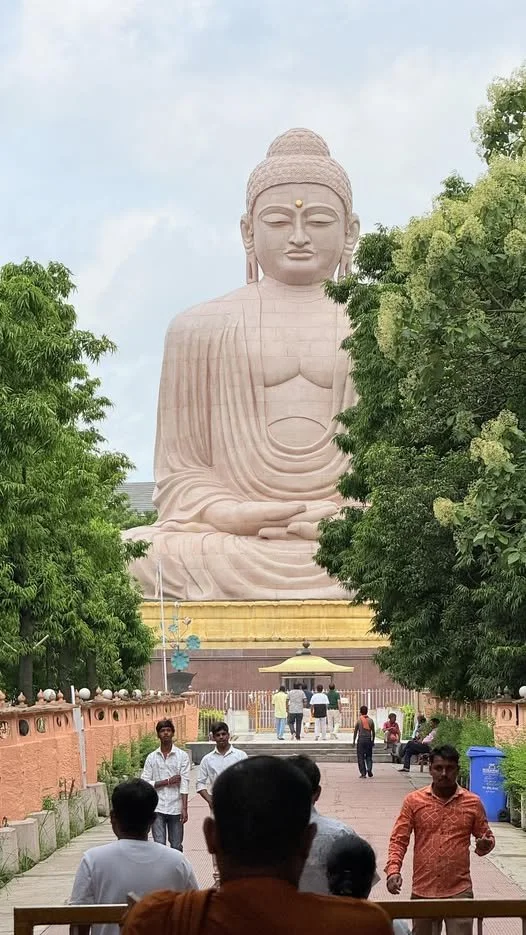
Great Buddha statue located in Bodh Gaya, Bihar, India. Designed by the master artist V. Ganapati Sthapati, its foundation was laid in 1982, and it was inaugurated by the 14th Dalai Lama in 1989
Sontosh Chakma
Architecture, sculpture and the understanding of form
One of the aspects of the Sthapati tradition that we find particularly compelling is that architecture was not historically understood as an isolated discipline. Across many South Indian Śilpa and Sthapatya traditions, creative practices such as architecture, sculpture, geometry, music and movement were often understood as different ways of exploring and expressing the same underlying principles of order, proportion and relationship (Mercay, 2008; Sthapati, 2005).
Within Mayonic literature, this understanding appears through what is described as the Five Fold Veda — a way of recognising architecture alongside poetry, music and dance as connected forms of knowledge rather than separate disciplines (Mercay, 2008). Each offers its own way of understanding how rhythm becomes experience, how proportion shapes feeling and how ideas take form in the world.
This perspective remains particularly visible in traditional temple architecture, where structure, ornament, procession, sound and atmosphere are experienced together rather than independently. Seen through this lens, architecture becomes more than the making of buildings; it becomes one way of understanding how humans experience space and give form to life.
Whether or not one adopts the philosophical foundations of this interpretation in full, there remains something compelling in the proposition that architecture extends beyond function and that meaningful places are experienced as complete environments rather than collections of isolated components.
Manifestation and lived experience
Within this interpretation of Vaastu, built form is understood as participating in a broader process through which space becomes experience and experience becomes embodied (Mercay, 2008).
The language used within these traditions differs significantly from contemporary scientific language and should not be interpreted as empirical science. However, as architectural philosophy, it offers a way of thinking about how proportion, atmosphere and spatial organisation contribute to lived experience.
For us, this remains one of the more interesting contributions of Vaastu. Not because it provides universal answers, but because it encourages architecture to begin with attention — attention to inhabitation, to relationships and to the qualities of life that spaces make possible.

More than a philosophy ~
While Vaastu can sometimes appear as philosophy, symbolism or doctrine, some lineages, particularly the work of Dr V. Ganapati Sthapati describe it differently: as a science of manifestation, concerned with understanding how subtle conditions become embodied as form.
Rather than focusing primarily on rules or superstition, this perspective explores relationships between space, time, proportion, rhythm, light, sound and the conditions through which life becomes expressed in the material world. In this understanding, architecture becomes less about imposing form and more about understanding how form emerges through relationship. (Mercay, 2008; Sthapati, 2005)
Want more resources like this?
Receive new articles, educational resources, supplier updates, and practical guidance on creating healthy, intentional homes inspired by nature.
Join our newsletter below.
______________
References
Acharya, P.K. (1934) Architecture of Mānasāra.
Mercay, J.J. (2008) Fabric of the Universe: The Origins, Implications and Applications of Vastu Science.
Michell, G. (1988) The Hindu Temple: An Introduction to Its Meaning and Forms.
Sthapati, V.G. (1996) Temples of Space Science.
Sthapati, V.G. (2005) Building Architecture of Sthapatya Veda.